Showing posts with label science experiment. Show all posts
Our Homeschool Electronics Class
One of the careers that Nicholas is interested in is Electrical Engineering. He has always had a pretty strong knack for engineering. He is always tinkering, creating, and building things. It just seems to come naturally for him. He enjoys working with electrical circuits and understands some basics about electricity but we wanted him to go a little deeper and learn more so he can really see if this is a field he would want to go into. The beauty of homeschooling is that we have more flexibility in our schedule to let our children really explore their passions. It also helps that our children are not allowed to have "screen time" during the school week so that allows for more free time for sparking their imaginations and interests.
One day when we were at Tanner's Electronics store just playing around with electrical components, we asked the owner if he happened to know of local classes or even curriculum to teach electronics to kids. I'm so glad that we talked to him because we learned that they homeschool their children as well! He gave us a great resource for a book which can be found for free on MIT's website. It is called MAKE Electronics by Charles Platt. It isn't a curriculum, per se, but it has lessons that build upon each other. We even found kits that come with all of the supplies needed for the electronics lab exercises. We even found a homeschool friend that wanted to do the course too so Stuart works through the book and the projects with Nicholas and his friend every Thursday night. The two boys love this class and they get excited about the projects they do each week.
Nicholas gets so excited about tinkering with electronics that when our coffee maker broke, he wouldn't let me throw it out. Instead the boys took it apart as part of their class work and learned about how it worked.
And, when this microwave was seen at the curb in front of a neighbor's house, I was asked to pick it up so the deconstruction and investigation of it could become another extension of Electronics Class! Note: microwaves can be dangerous to take apart so you must do some research before you try to tackle this project.
We also have a big trunk under the school table that Nicholas is using to collect other dead or broken things that I would like to throw away like an old PC, a monitor, an electric pencil sharpener, a kid's version of a tablet, and much more. The trunk is so full that we can no longer fully close the lid on it. I think he has enough electronic projects now to last him an entire year! But do you want to know something cool? Nicholas doesn't just dive into taking everything apart. Stuart has a great understanding of electronics so Nicholas always wants to wait until Stuart is available to do it with him so he can teach him about the components and what they do.
I love listening in on Stuart and the boys during Electronics class. I smile as I hear the excitement in the boys' voices as they learn cool new things or they successfully make their electronic projects work correctly. Stuart, thank you for pouring your time and energy into making this class so great for them, especially when you do it after a long day at work.
Exploring Creation with Human Anatomy and Physiology {Review}
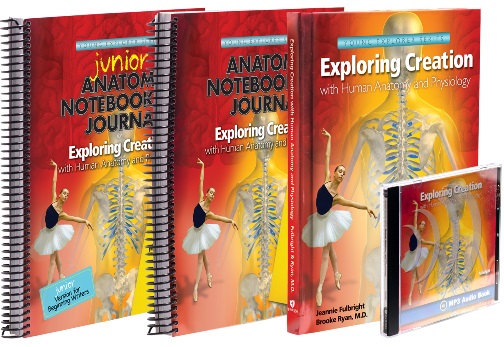
We have used the Young Explorer series from Apologia for homeschool science in the past so I was excited to have the opportunity to review their Exploring Creation with Human Anatomy and Physiology curriculum for the Homeschool Review Crew. Apologia sent us a textbook, an audio CD, an Anatomy Notebooking Journal, as well as a Junior Anatomy Notebooking Journal to try.

This curriculum is an introduction to human anatomy from a Christian perspective. The hardcover text book is the heart of the curriculum. It is divided into the following 14 chapters:

When they learned about the different organelles inside the human cell, they used jello and various kinds of candy to make an edible cell. Yum!
To demonstrate the importance of our skeletal system, the children made clay people. First they made one without any "bones". He fell over right after I took his picture. Second, they made one with a toothpick skeletal system and he is still standing today.
Did you know that your arm span is about the same width as your body is tall? The children learned that and then did the "Try This!" demonstration to measure it for themselves.
In summary, we love this curriculum. It is a great introduction to anatomy and the demonstrations make it a fun and more memorable way to learn. I also appreciate that Apologia offers different notebooking journals for different ages. We have also enjoyed the fact that the curriculum gives some additional projects and reading materials for each lesson in case your student wants to dive in deeper with a particular topic.

We have used the Apologia Young Explorer series for most of our science curriculum. However, here are two other Apologia products that I have reviewed in the past:
If you would like to read some additional reviews about the Apologia Exploring Creation with Human Anatomy and Physiology products from other reviewers on the Homeschool Review Crew, please click on the banner below:


- Introduction to Anatomy and Physiology
- The Skeletal System
- The Muscular System
- The Digestive and Renal Systems
- Health and Nutrition
- The Respiratory System
- Life in the Blood
- The Cardiovascular System
- The Nervous and Endocrine Systems
- The Nervous System Extended
- Your Senses
- The Integumentary System
- The Lymphatic and Immune Systems
- Growth and Development
The MP3 audio CD is a recording of the author, Jeannie Fulbright, reading the text aloud. Her voice is soothing and the kids enjoyed listening to her. While the CD was playing, my kids read along in the textbook and looked at the graphics. However, as with any read aloud we do, my children like to stop and discuss everything we read. It took a little longer for us to get through the material when we had to keep starting and stopping the CD so they could talk or ask questions. My children prefer to just read the text aloud or have me read it aloud to them so we can more naturally discuss the material as we go along. That is just the way we do read alouds together. I think the CD would be great for other families, especially a student studying this independently or if you wanted to just play the CD in the car.
There are two Notebooking Journals available. The regular one is intended for older children which I let Nicholas complete. It contains more review questions and a vocabulary crossword puzzle. The Junior Notebooking Journal contains some coloring pages for each lesson and less writing on most of the other notebook pages. Rachel is in third grade and she likes the Junior version better although I think she is old enough to do fine with the regular version but it would definitely take her a little more time to complete.
For example, here is a crossword puzzle that Nicholas completed using vocabulary from lesson one.
But with the Junior version, Rachel just had to glue the vocabulary word on the definition to create a lift-the-flap page.
I just love that each lesson has a scripture copywork page that relates to the lesson in some way. Both journals offer a sample copywork in both manuscript and cursive so your child can complete which ever one is a better fit for them.
But my favorite part of the Notebooking Journals are the mini-books. Both the regular version and the Junior versions contain these. Check out my video below to see two examples.
Each lesson in the textbook gives an easy-to-read explanation of the various systems along with several "Try This!" demonstrations and experiments. The experiments are easy to follow and they use materials that you most likely already have at home. Here are just a few that we did in the first couple of lessons.
As they learned about the history of the study of anatomy, they learned about how ancient Egyptians embalmed bodies with salts to preserve them because they believed the bodies would be needed in the afterlife. So the kids did an experiments with various ratios of table salt, epsom salt, baking soda, and a control to see which mixture was the most effective at drying out apple slices. This was a really fun experiment!
After learning about the invention of glass lenses and microscopes, they did an experiment with a drop of water to demonstrate how a magnifying glass works.

When they learned about the different organelles inside the human cell, they used jello and various kinds of candy to make an edible cell. Yum!
To demonstrate the importance of our skeletal system, the children made clay people. First they made one without any "bones". He fell over right after I took his picture. Second, they made one with a toothpick skeletal system and he is still standing today.
Did you know that your arm span is about the same width as your body is tall? The children learned that and then did the "Try This!" demonstration to measure it for themselves.
In summary, we love this curriculum. It is a great introduction to anatomy and the demonstrations make it a fun and more memorable way to learn. I also appreciate that Apologia offers different notebooking journals for different ages. We have also enjoyed the fact that the curriculum gives some additional projects and reading materials for each lesson in case your student wants to dive in deeper with a particular topic.

We have used the Apologia Young Explorer series for most of our science curriculum. However, here are two other Apologia products that I have reviewed in the past:
If you would like to read some additional reviews about the Apologia Exploring Creation with Human Anatomy and Physiology products from other reviewers on the Homeschool Review Crew, please click on the banner below:


Fascinating Chemistry {Review}
The Home School Review Crew has been reviewing several different online courses from Fascinating Education. The courses are intended for high school but middle school students who are strong in math skills can do well in these courses too. They offered us three courses to choose from: Fascinating Chemistry, Fascinating Biology, and Fascinating Physics. They recommend taking their courses in that specific order so I chose Fascinating Chemistry.

The course was created by Dr. Sheldon Margulies, a retired neurologist and professor at several impressive medical schools. He has also published three educational textbooks. As you look through the Fascinating Education website, you will see that Dr. Margulies has a passion for science that he is excited to share with others. He has created these courses with moving slides and audio presentations together to help ignite "right brain" learning, making the educational experience more complete than simple reading a text book.
The Fascinating Chemistry course is taught over 18 lessons. During the lesson, Dr. Margulies stops and asks questions for the student to think about and there is always a review of the material that has already been covered. There is also a printable transcript of the lesson if your student wanted to just print it and read it. However, those are simply not as interesting as watching the presentations.
You can view the complete course outline for Fascinating Chemistry and even try a sample lesson HERE.
There are chemistry labs in most of the lessons. They typically use basic household items but there are some chemicals and other supplies that you will probably need to purchase. As with any science experiment, students are encouraged to use safety gear like eye protection and adult supervision is required.
Each lesson has an online test which is automatically graded and the student can review his results to see what he missed. There are also printable tests and answer keys if you want to administer the test to your student on your own.
Fascinating Chemistry does not retain the test scores so if you want to keep a copy for your records then be sure to review the quiz results and print them right away. It does mention this on the website but I did not remember that until I went back later and couldn't find Nicholas' earlier test results that I had not recorded.
Other members of the Home School Review Crew have tried Fascinating Chemistry as well as other products such as Fascinating Biology and Fascinating Physics. If you would like to read reviews from crew members on any of these products, please click on the banner below:


Other members of the Home School Review Crew have tried Fascinating Chemistry as well as other products such as Fascinating Biology and Fascinating Physics. If you would like to read reviews from crew members on any of these products, please click on the banner below:


SchoolhouseTeachers.com Review
I've looked at SchoolhouseTeachers.com several times over the last few years and have considered signing up for a membership but just never took the plunge. As a member of The Old Schoolhouse Homeschool Review Crew I was recently given the opportunity to review a Yearly Membership with SchoolhouseTeachers.com. Wow! Now that we've had a few weeks to get a feel for the site and all that it has to offer, I'm kicking myself for not joining sooner!

The new SchoolhouseTeachers.com website is amazing! It is easy to use and navigate. They offer Online Classes and Online Electives to use in your homeschool, either as your full curriculum or as a supplement to what you are already using. There are Scope and Sequence charts, lesson plans, and printable certificates of completion.
Homeschooling children of multiple ages? No problem! They have course work for students preschool - high school.

We have used several of their history lessons while studying the Renaissance. There are weekly lesson plans, lapbooks, notebooking pages, as well as links to videos and related maps as well as hands-on activities like games, recipes, and crafts to really bring the Renaissance to life for my kids.
In addition to the courses, we have also enjoyed some of the special online access to products included in our membership like The World of Animals through the World Book eBook Library and learning about how Christopher Columbus discovered American through watching the amazing video series called Drive-Thru History. These have been so much fun for my kids to explore!
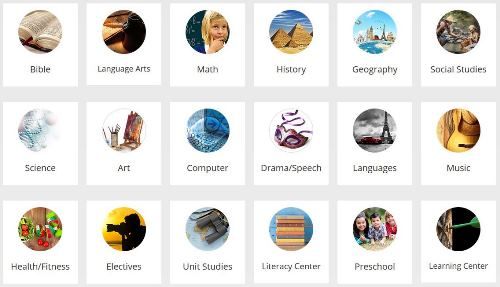
Just take a look at the subjects below that are covered in the SchoolhouseTeachers.com courses:

In addition to the wealth of curriculum on the site, there is also an abundance of homeschool parent support resources on the site. As a member you can download several different planners. Here are just two of them which are for homeschool parents to help organize their homeschool as well as manage their home. However, they also offer primary, intermediate, and high school student planners, as well as a planner for special needs students.
There is also a Custom Schedule Builder to help you organize your homeschool day as well as online access to Applecore Recordkeeping for tracking your students' portfolio, coursework, grades, and attendance.
SchoolhouseTeachers.com really has everything you might need for your homeschool!
Be sure to join SchoolhouseTeachers.com during their Super Christmas Sale and save 50% by using code: CHRISTMAS for $9.95/month or CHRISTMASYEAR for $90/year. This is really a great deal! The sale ends on January 15th so HURRY and lock in your promo rate.

To read more reviews for SchoolhouseTeachers.com from other members of The Old Schoolhouse Homeschool Review Crew, please click on the graphic below:

My kids and I have thoroughly enjoyed using SchoolhouseTeachers.com in our homeschool and I have written my honest opinion about this product. Although I was given a free Yearly Membership in order to research the product and write this review, I have benefited so much from it that I will definitely renew our membership when this one expires.

Nanotechnology: Homeschool Day at the Perot Museum
We love Homeschool Day at the Perot Museum! The museum sets up 9 themed tables throughout the regular museum area. Each table has a hands-on activity to help teach the scientific concepts to the kids. As they complete each activity, they get their card stamped and can receive a certificate once they have finished.
Last semester's theme was on Forensics. The kids went to each station where they learned different aspects of the science behind detective work and they gained a new clue to solving a mystery at the end.
This time the theme was Nanotechnology!
We started with learning just how small a nanometer is. It is one billionth the size of a meter! That's really small! This video is not from the Perot but I showed it to the kids before we went to the museum to help them understand just how small this is.
The kids traced their hands. Rachel's hand is about 140 million nanometers long! That sounds huge, doesn't it?
Nicholas learned that he is about 1.6 TRILLION nanometers tall!
They used a mystery box to let their fingers scan over the tops of objects and then make a drawing of them just like a scanning electron microscope does by scanning objects with a beam of electrons.
They used microscopes to study things up close.
Nicholas used it to look at the surface of a piece of metal.
They learned about UV light which is electromagnetic radiation with a wavelength of about 10-400 nanometers, shorter than visible light but longer than x-rays. They made bracelets with UV beads that change from white to purple when exposed to UV light. They are a fun way to remind yourself that you need sunscreen when you are out in the sun!
I loved the ferrofluid exhibit the most. Ferrofluid is a liquid made up of nanoscale magnetic particles. You can run a magnet over a tube of it and watch all of the magnetic pieces come together. It was fascinating to watch.
Our currency is printed with ferrofluid ink so you can run a magnet over a dollar bill and it will move ever so slightly. This is just one of the tests that can be used to determine if the bill is counterfeit.
They learned about carbon atoms and how they can form buckyballs and nanotubes then they got to make their own models of the two.
The kids have fun exploring the regular museum exhibits on their own as well. Nicholas used the Build Your Own Bird exhibit to create a "Stealth Thrasher".
They went head to head with each other as dinosaurs.
And they even raced a T-rex!
Once we had completed the activities, we all headed to El Fenix for lunch. It was lunch time and they were super busy so our big group of 15 was a lot for them to take on. The moms ended up sitting at one table while the kids sat at their own table next to us. There were 10 kids and they are all different ages. But these kids behaved nicely and were really well-mannered.
The Perot Museum of Nature and Science is located at 2201 N. Field Street in Dallas. For more information about their programs, please check out the Perot Museum website or follow Perot Museum on Facebook.
Learning Astronomy with the American Astronomical Society
“Philosophy [nature] is written in that great book which ever is before our eyes -- I mean the universe -- but we cannot understand it if we do not first learn the language and grasp the symbols in which it is written. The book is written in mathematical language, and the symbols are triangles, circles and other geometrical figures, without whose help it is impossible to comprehend a single word of it; without which one wanders in vain through a dark labyrinth.”
- Galileo Galilei
The kids had a great opportunity to attend a free student event at the American Astronomical Society's Convention at the Gaylord Texan Convention Center in Grapevine, TX. They got to experience hands-on science with some world class astronomers!
The event is geared towards middle school and high school students but younger siblings can attend too as long as they are accompanied by a parent. I'm really glad that Rachel could come with us because she interacted with the exhibitors and learned right along with the older kids.
The event started with a presentation from Nick Siegler from NASA Jet Propulsion Laboratory on Exoplanets and the Search for Life. It was a great talk about planets outside our solar system that show potential for life. I found a video of his complete talk on the internet. It's called The Search for Planets, Habitability, and Life in our Galaxy.
At the end of the presentation, the kids were encouraged to consider pursuing a career in Astronomy. But as was pointed out, you don't have to be a rocket scientist to work for NASA. The study of astronomy certainly requires scientists and engineers but they also need people who excel at math, can work with computers to develop simulators and computer models, as well as people with a love for geology to help them study rock formations and terrain on other planets. There is a wide range of people needed for space exploration and I love that kids were introduced to the idea that they might have an integral part in future space studies even if they can't name all of the constellations in the sky.
Next we separated into groups. Our group had about 10 kids. We went into the convention center where exhibits packed the room. Exhibitors included observatories, researchers, colleges, and product vendors from all over the world!
I couldn't help but notice the Career Center when we first walked in. Again, they are reaching out and trying to get people connected with a career in Astronomy. As a parent of a kid who loves learning about space, I am glad to see such eagerness to recruit people into the field.
I was a little worried that there would be tons of kids at each station and it would be a struggle for kids to hear the presenters and see what was going on but I was so wrong. The plan was well thought out. Each group started at a different exhibitor then after about 15 minutes a bell would ring and we would move to the next assigned exhibitor table. Our group was the perfect size for everyone to participate and hear what was being said.
We started at the table for the Space Science Institute. from Boulder, CO. They had a presentation for the kids and then challenged them to put a set of picture cards in order of distance from the Earth. The cards were of things like the moon, the Hubble telescope, International Space Station, etc. Then they were given another challenge of putting a different deck of picture cards of space things in order based on smallest to largest. All the kids seemed engaged and interested.
Our group visited the presenter for the Planetarium at UT Arlington where they talked about planets and orbits. I had really been worried that all of these incredibly smart scientists would only want to talk to other brainiacs and not really want to interact with kids but I was so wrong. By just the second table, I was realizing that these scientists really just wanted to share their passion for science with everyone, but they especially wanted to reach out to the next generation.
We visited with representatives from the National Radio Astronomy Observatory where we learned about the use of techniques to study radio waves emitted from outer space that are not visible to us otherwise. With these special glasses, we were able to see how radio waves look compared to what we normally see.
Another example we saw was how infared technology could be used to see which lidded coffee cup actually contained hot coffee. This technology is used to on a much larger scale to study objects in the sky.
Next we visited the Ball Aerospace and Technologies exhibit where we met Missions System Engineer, Paul Lightsey. He explained some of his work on the James Webb Telescope. We learned that the mirrors are coated in gold because gold works the best at reflecting infared radiation and this will help NASA see even the smallest objects out in space. I found a YouTube video of a talk that he did on the James Webb.
We met with professors and students at the University of Arizona and learned about different types of meteorites. We even got to hold very tiny pieces of the moon and Mars.
Nicholas loves all things rock so this was one of his favorite exhibits. He enjoyed asking questions and talking with them. As I mentioned earlier, all of these scientists were excited to talk to the kids and they took time to answer all of their questions. I was really impressed.
We visited with SPIE which is the International Society of Optics and Photonics. We learned how different light frequencies produce different types of light. We can use this knowledge to determine what substances are out in space by the light they produce.
SPIE had a great tool that they passed out to us. They are called Rainbow glasses and it shows the full color spectrum for visible light. They are really cool!
We also visited with Digitalis Education Solutions. Oh my! Every homeschooler needs one of these portable planetariums! Seriously look at this thing!
We got to go inside and see a short presentation on Earth's place in the galaxy and constellations. I could really get into teaching astronomy if I had one of these!
We met with Sloan Digital Sky Survey. They created incredibly detailed three-dimensional maps of the universe. We got to learn a little about their process.
Rachel enjoyed this exhibit because the two presenters were both female so she felt a little less intimidated. They were very knowledgably but very friendly as well. And they passed out amazing little candies that had a picture of their telescope printed on them!
We learned about the Chandra X-Ray Observatory which is NASA's flagship mission for radio astronomy. It was launched in 1999 and it orbits outside Earth's atmosphere at around 65,000 miles high. It has been used to study exploded stars, black holes, and dark matter.
Chandra works through the use of some very sensitive mirrors nestled inside it. The kids got to get some hands-on use with mirrors as they adjusted them to direct a laser beam to a sensor at the end of the table.
Our group time was almost up but we got to visit with one more exhibit - Astron, the Netherlands Institute for Radio Astronomy. They use high tech radio telescopes on the ground to pick up radio waves from outer space and turn those into a picture of what is out there.
They even had us do a fun game to see just how it all works by assigning some of us to be the radio telescopes and others to be the radio waves. How creative and fun!
The student session was officially over but there had been some other exhibits that we wanted to see so I got permission for us to wander around for just a little bit on our own. If you know me, you can imagine that I was drawn to this table of books! They were some impressive looking books that I was considering buying but then realized they were college-level. I think I can hold off on those for a little longer.
We visited with the University of North Texas' exhibit and got to hold the largest piece of meteorite we've ever seen. We talked to them some about how to identify meteorites as well as about the UNT planetarium and star parties.
We saw a very scaled down version of a science balloon. These are used to carry scientific instruments for space and earth science research up to a float altitude where stratospheric winds will drive it along. Some aspects of it can be radio controlled from the ground such as when to release its payload.
We learned about pulsars which are spinning neutron stars created from a supernova when a star exploded. It is always spinning and releasing electromagnetic radiation from a certain point. We can only see this beam of radiation when it is directly facing us so it appears to us that it is blinking but it is actually just rotating around.
The kids got to make their own pulsar models. They attached two LED lights to a battery, attached a string and wrapped it all in clay. They held it up by the string and then twisted the string a little. When they let go, the "pulsar" spun around quickly and the lights looked like they were blinking. It was a really great demonstration!
We got to play around in front of an infared camera.
We were sent home with great goody bags full of information, toys, and even our own Galileoscope to keep!
This was a truly amazing experience and I'm so grateful for all of the scientists and researchers who spent time with the kids today to answer their questions and open their eyes to the amazing world of Astronomy.
Subscribe to:
Posts (Atom)